

If you plan to leave your job or hire a new employee in British Columbia, you may face a non-compete clause. These clauses try to limit where and how you can work after employment ends. You need to know whether the law will actually enforce that restriction.
Non-compete agreements are legal in British Columbia, but courts enforce them only in limited and carefully defined situations. Judges treat them as a restraint of trade, which means they start from a position of caution. If the clause goes too far in time, geography, or scope, a court will likely refuse to enforce it.
In this article, you will see how BC law defines non-compete agreements, what legal rules apply, and how courts assess reasonableness. You will also learn about recent case trends, practical risks, and common alternatives such as non-solicitation and confidentiality clauses. This context helps you assess your rights and obligations with clarity.
Overview of Non-Compete Agreements in British Columbia
In British Columbia, courts treat non-compete clauses as restraints of trade and review them with strict scrutiny. You must draft these agreements carefully, with clear limits on time, geography, and restricted activities.
Definition and Purpose of Non-Compete Agreements
A non-compete agreement is a contract term that restricts where and how you may work after your employment ends. It aims to prevent you from working for a competitor or starting a competing business for a set period.
Employers use non-competes to protect confidential information, client relationships, and trade secrets. However, courts in British Columbia often view these clauses with caution because they limit your ability to earn a living.
The courts have historically been skeptical about enforcing non-competition agreements, as they are a restraint of trade. To be valid, the clause must be reasonable between you and your employer and not harm the public interest.
If a non-solicitation clause can protect the employer’s interests, a court may refuse to enforce a broader non-compete.
Typical Clauses in British Columbia Non-Competes
Most non-competes in British Columbia include clear limits on:
Duration (for example, 6 to 12 months)
Geographic scope (such as a specific city or region)
Restricted activities (defined types of work or services)
If the clause is vague or overly broad, a court will likely find it unenforceable. Courts require precise drafting and will not rewrite a poorly written clause to make it valid.
Poorly drafted non-competes can create serious legal risk for employers. You may face legal action if you breach an enforceable clause, including claims for damages or injunctions.
Courts often prefer narrower non-solicitation and confidentiality clauses because they restrict you less while still protecting business interests.
Industries Commonly Affected
Non-compete clauses appear most often in industries where you have access to sensitive business information or strong client connections.
These industries commonly include:
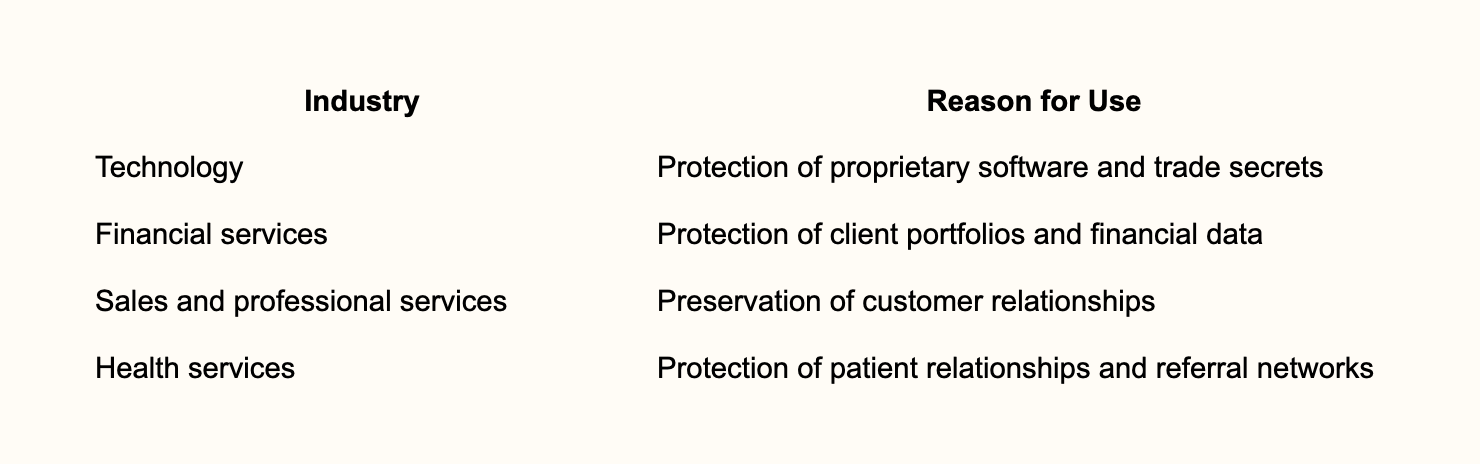
While non-competes are not automatically illegal in British Columbia, courts apply strict standards before enforcing them.
If you work in a senior or highly specialized role, your employer is more likely to require this type of clause. However, enforceability depends on the exact wording and the specific facts of your employment.
Legal Framework Governing Non-Competes in BC
British Columbia does not ban non-compete clauses outright, but courts treat them with caution. You must understand both legislation and common law rules to assess whether a restriction will stand.
Employment Standards Act and Relevant Legislation
The Employment Standards Act (ESA) does not directly prohibit non-compete clauses. However, it sets minimum standards for termination, notice, and severance, which affect how and when restrictive covenants apply.
If you terminate an employee without proper notice or pay in lieu, you may weaken your ability to enforce a non-compete. Courts often examine whether you acted fairly before granting equitable remedies such as an injunction.
You must also consider human rights and competition principles. A clause that limits someone’s ability to earn a living may raise broader legal concerns.
Common Law Principles
BC courts rely heavily on common law when assessing non-compete clauses. At common law, these clauses are presumed unenforceable unless you prove they are reasonable.
To enforce a non-compete, you must show it protects a legitimate business interest, such as:
Confidential information
Trade secrets
Strong customer relationships
You must also show the clause is reasonable in:
Time (length of restriction)
Geographic scope
Scope of activities restricted
Courts prefer non-solicitation clauses over non-competes. If a non-solicitation clause can protect your interests, a broader non-compete will likely fail.
Many agreements fail due to poor drafting.
Court Interpretation in BC
BC courts interpret non-compete clauses narrowly. If wording is unclear or overly broad, the court will not rewrite it to make it reasonable.
You must draft the clause carefully from the start. Courts apply a strict test and place the burden on you as the employer to justify the restriction.
For example, a province-wide ban may be unreasonable if your business operates only in one city. A restriction that lasts two years may fail if six months would have been sufficient.
Courts also consider the employee’s role. A senior executive with access to sensitive data faces a different analysis than a junior employee.
Enforceability Criteria for Non-Compete Agreements
Courts in British Columbia apply strict standards to non-compete clauses. You must show that the clause is reasonable, protects a real business interest, and provides proper consideration to the employee.
Reasonableness of Duration and Geographic Scope
You must limit a non-compete to a reasonable time period and geographic area. Courts in BC often refuse to enforce clauses that are broad or unclear.
A short duration, such as six to twelve months, is more likely to stand than a multi‑year restriction. The longer the time period, the stronger your justification must be. If you cannot explain why you need the restriction for that length of time, the court may strike it out.
Geographic scope also matters. You must define a clear area, such as a specific city or region. A province‑wide or nationwide ban may fail if your business only operates locally.
BC courts apply strict scrutiny to these terms. If the wording is vague or overly broad, the court will not rewrite it for you.
Legitimate Business Interests
You must show that the clause protects a legitimate business interest, not just a desire to reduce competition. Courts will not enforce a non-compete simply because you want to prevent a former employee from working elsewhere.
Legitimate interests often include:
Protection of trade secrets
Confidential client information
Strong customer relationships
Specialized training unique to your business
If a non-solicitation or confidentiality clause would protect your interests, a court may reject a broader non-compete. BC courts treat non-competes as a last resort.
The primary concern is whether the restriction goes beyond what you reasonably need.
Consideration Provided to Employees
You must provide valid consideration for the non-compete to be enforceable. If you include the clause at the start of employment, the job offer itself usually counts as consideration.
If you add the clause after employment has begun, you must give something new in exchange. This may include:
A raise
A bonus
A promotion
Additional benefits
Without new consideration, the clause may fail even if it is otherwise reasonable.
Courts in Canada assess enforceability using clear criteria tied to reasonableness and proper exchange of value. If you cannot show fair exchange and clear limits, the court will likely refuse enforcement.
Judicial Trends and Case Law
British Columbia courts apply a strict test to non‑compete clauses. You must show that the clause protects a real business interest and goes no further than necessary in time, geography, and scope.
Key British Columbia Court Decisions
British Columbia courts start from the rule that restraints on trade are unenforceable unless you prove they are reasonable. The Supreme Court of Canada has confirmed that courts prefer non‑solicitation clauses over non‑compete clauses because they limit competition less while still protecting business interests, as explained in E. v. J.G. Collins Insurance Agencies Ltd..
You must draft the clause with clear limits. Courts examine three main factors:
Time – Is the duration no longer than necessary?
Geographic area – Does it match where you actually operate?
Scope of activity – Does it restrict only the work that creates real risk?
If the wording is vague or too broad, the court will likely refuse to enforce it. Judges do not rewrite clauses to fix errors. If the clause fails, you cannot rely on it.
Recent Developments in Non-Compete Litigation
Recent appellate decisions across Canada show a clear divide between employment and commercial contexts. Courts remain cautious in employment cases but show more willingness to enforce clauses tied to the sale of a business. The Ontario Court of Appeal upheld a restrictive covenant after a dental practice sale in Dr. C. Sims Dentistry Professional Corporation v. Cooke, stressing the commercial setting.
You should expect similar reasoning in British Columbia. When you sell a business, courts view both parties as having equal bargaining power. In that setting, judges give more weight to protecting goodwill.
In contrast, if you rely on a non‑compete in a standard employment contract, you face a high bar. Courts require clear evidence that a narrower clause, such as non‑solicitation, would not protect your interests.
Alternatives to Non-Compete Agreements
When a non-compete clause may not hold up in British Columbia, you can use narrower tools that focus on specific risks. Courts in B.C. often favour targeted limits over broad bans on competition, especially where you can protect clients and confidential information without blocking someone from working.
Non-Solicitation Clauses
A non-solicitation clause restricts you from approaching your former employer’s clients, customers, or employees for a set time. It does not stop you from working for a competitor. This narrow focus makes it more likely to be enforced in British Columbia.
Courts apply strict standards to restrictive covenants. Judges assess whether the clause is reasonable in scope, time, and geography.
To improve enforceability, you should:
Limit the clause to specific clients you dealt with
Set a clear and short time limit
Avoid vague terms like “all potential customers”
A well-drafted non-solicitation clause protects real business interests without placing a broad restraint on trade.
Confidentiality Agreements
A confidentiality agreement requires you to protect trade secrets and sensitive business information. This includes client lists, pricing data, marketing plans, and technical processes.
Unlike non-compete clauses, confidentiality terms often remain enforceable for a longer period. Courts are more willing to uphold them because they protect information rather than restrict employment.
Employers across Canada rely on confidentiality and other targeted clauses instead of broad non-competes. Canadian courts tend to uphold practical alternatives that directly address legitimate business interests.
Your agreement should clearly define what counts as confidential information. It should also state how long the duty lasts and what happens if you breach it.
Precise drafting reduces uncertainty and strengthens enforceability.
Implications for Employees and Employers
Non-compete clauses can create legal and financial risk if you draft or sign them without care. Courts in British Columbia apply strict standards and often refuse to enforce terms that go beyond what is necessary to protect a real business interest.
Risks of Enforcing Unreasonable Clauses
If you try to enforce a broad non-compete, the court may strike it down in full. In BC, judges view non-compete clauses as a restraint on trade and enforce them only when they are clearly necessary.
You face higher risk when the clause:
Covers a wide geographic area
Lasts too long
Restricts work that does not compete directly
Protects interests that a non-solicitation clause could address
If you are an employer, you may spend significant time and money on litigation and still lose. A poorly drafted clause can also damage your reputation and employee relations.
If you are an employee, signing an unreasonable clause can limit your job options. Even if the clause may not stand in court, you could face legal threats or delays when starting new work.
Best Practices for Drafting and Reviewing Non-Competes
You should use a non-compete only when other tools cannot protect your business. Employers should limit them to senior executives, highly technical staff, or high-level managers.
If you are an employer, take these steps:
Define the restricted activities with precision
Limit the geographic area to where you actually operate
Keep the time period as short as reasonably possible
Consider a non-solicitation or confidentiality clause instead
You must also provide proper consideration, especially if you add the clause after employment begins.
If you are an employee, review the wording carefully before you sign. Ask whether the restriction matches your role and whether it is necessary. You should seek legal advice if the clause could limit your future employment in a meaningful way.
Provincial and National Considerations
Your rights and obligations depend on where you work in Canada. British Columbia follows common law rules, while other provinces and the federal government have taken different approaches to non-compete clauses.
Comparison with Other Canadian Provinces
In British Columbia, there is no statute that bans non-compete clauses. Courts rely on common law principles. Judges assess whether the clause is reasonable in time, geography, and scope of activities.
Ontario takes a different approach. It has enacted legislation that generally prohibits non-compete clauses in employment agreements, with limited exceptions for certain executives and in business sale situations.
Other provinces, such as Alberta and Saskatchewan, continue to apply common law rules similar to British Columbia. Courts in those provinces also require employers to prove that a non-compete protects a legitimate business interest and is narrowly drafted.
If you work in multiple provinces, you must review which law governs your contract. The applicable province can change the outcome.
Impact of Federal Legislation
Federal developments also affect how you assess non-compete clauses. While employment law is mainly provincial, national policy can influence the landscape.
In the United States, the Federal Trade Commission has moved to ban non-compete clauses nationwide.
Canada has not enacted a nationwide ban. However, federal competition policy and proposed reforms have increased scrutiny of restrictive employment practices.
If you work in a federally regulated industry, such as banking or telecommunications, federal rules may apply to parts of your employment relationship. You should confirm whether federal or provincial law governs your agreement, as this affects how a court reviews any non-compete clause.
The Final Verdict
While non-compete agreements can provide protection for businesses in BC, they are only enforceable under limited and carefully defined circumstances. Ensuring that these agreements are properly drafted and reasonable is essential to their validity.
For professional advice on drafting, reviewing, or enforcing non-compete agreements, contact the attorneys at Parr Business Law. Our experienced team can help you create legally sound agreements that protect your business interests.