
Corporate Wills

If you own shares in a private company, your estate plan has a problem your personal will was never built to solve. Probate fees in BC are calculated on the value of the assets that pass through your estate, and for an incorporated owner, that can mean a substantial bill on shares your family never intended to sell. A Corporate Will keeps those shares out of the probate application entirely. At Parr Business Law, our lawyers draft Corporate Wills for incorporated professionals and family business owners across British Columbia.
Corporate Wills in BC: What Business Owners and Shareholders Need to Know
A Corporate Will, sometimes called a secondary will, deals with your company shares and other qualifying corporate assets separately from everything else you own. Your personal will handles the house, the bank accounts, and the family possessions. The Corporate Will handles the business.
The point of splitting them is cost and control. Private company shares generally do not need to pass through probate in British Columbia, so keeping them in a separate document means their value stays out of the probate calculation. On a company worth a few million dollars, that difference is real money.
There is a second benefit owners tend to appreciate just as much. A probated will becomes part of the public court record. A Corporate Will that never goes through probate keeps your company's ownership structure private.
What Is a Corporate Will?
A Corporate Will is a valid, standalone will that governs only the assets you assign to it. It is signed with the same formalities as any other will under BC's Wills, Estates and Succession Act, and it names its own executor.
What makes it a Corporate Will is not a special legal category. It is the scope. You draft it to cover the corporate assets that can transfer without a grant of probate, and you draft your personal will to cover everything else.
How a Corporate Will Differs From Your Personal Will
Your personal will is the document most people picture. It names an executor, distributes your estate, and in most cases has to be probated before banks, land title offices, and other institutions will act on it.
A Corporate Will is narrower by design. It covers private company shares, shareholder loans, and similar assets whose transfer depends on the company's own directors rather than a court grant. Because no institution demands a grant of probate for those assets, the will that governs them never has to be filed with the court.
The two documents work together. Neither one replaces the other.
Whether Multiple Wills Are Valid in BC
Multiple wills are a recognized planning tool in British Columbia. BC courts have accepted the use of a primary will alongside a secondary will limited to corporate assets, and BC practice has followed a path similar to the longer line of case law developed in Ontario.
The concept is settled enough to rely on. The execution is where estates get into trouble, which is the subject of a later section on this page.
How Dual Wills Work in British Columbia
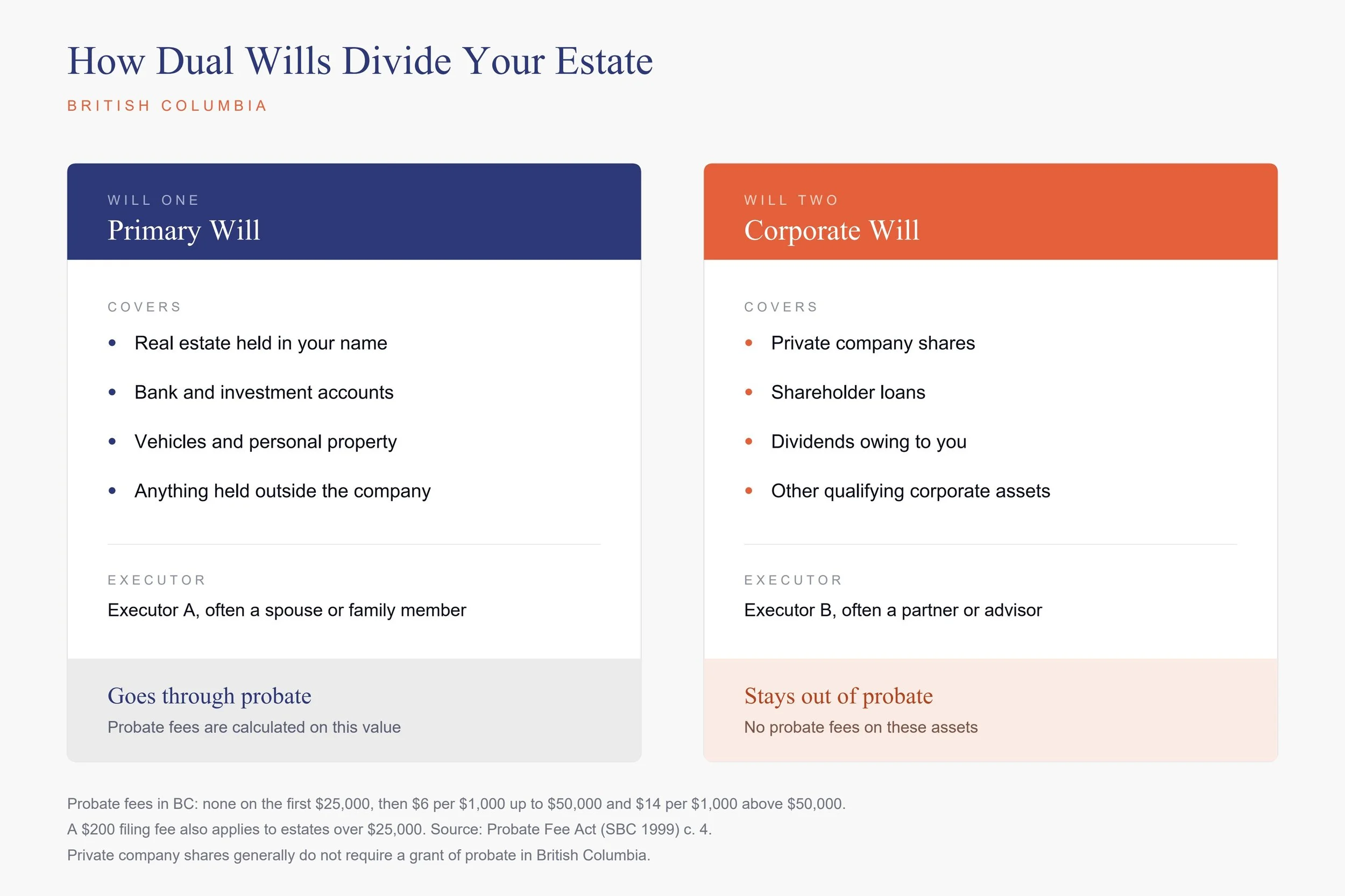
The mechanics are straightforward once you see the two documents side by side. You sign both. Each covers a defined pool of assets, and after your death, only one of them goes to court.
The Primary Will and the Assets It Covers
Your primary will covers the assets that need a grant of probate before anyone can deal with them. Real estate held in your own name, bank and investment accounts, vehicles, and personal property all sit here.
This is the will your executor files with the court. Probate fees are calculated on the value of the assets it governs, which is precisely why you want the company shares somewhere else.
The Corporate Will and the Assets It Covers
Your Corporate Will covers shares in your private company, along with shareholder loans, dividends owing to you, and other corporate assets that transfer without a court grant.
Shares in a private company change hands through the company's own records. The directors approve the transfer and update the central securities register. No land title office or bank is standing in the way asking for a probated will, so the Corporate Will can do its job quietly.
Publicly traded shares do not belong here. Neither does anything you hold personally outside the company.
Why Each Will Needs a Different Executor
Name a different executor for each will. If one person serves both roles, the estate loses much of the separation you were trying to create, and the court application for the primary will can end up pulling the corporate assets back into view.
In practice, this often means a spouse or family member handles the personal estate while a business partner, an adult child working in the company, or a trusted advisor handles the shares. Choose the corporate executor for their ability to deal with a going concern, not only for family reasons.
Probate Savings and Other Benefits
Cost is the reason most owners come in asking about Corporate Wills. It is not the only reason they leave with one.
Reducing Probate Fees on Private Company Shares
British Columbia charges no probate fee on the first $25,000 of estate value, roughly 0.6 percent on the portion between $25,000 and $50,000, and roughly 1.4 percent on everything above $50,000.
Run that against a company. Shares worth three million dollars that pass through probate attract roughly $42,000 in fees. The same shares governed by a properly drafted Corporate Will attract none. You can estimate your own exposure using our BC probate fee calculator.
One important limit applies. A Corporate Will reduces probate fees. It does not reduce the income tax your estate owes on death.
Keeping Company Ownership Private
A will that goes through probate becomes a public court document. Anyone willing to pay the search fee can read it, including competitors, suppliers, and people who would rather know than not know what your company is worth and who owns it now.
A Corporate Will that stays out of probate stays private. For owners with partners, minority shareholders, or a succession plan they would prefer not to broadcast, that privacy is often worth as much as the fee savings.
Faster Access to the Business After Death
Probate takes months. A business does not pause while it waits.
Because the Corporate Will does not need a grant, the executor named in it can deal with the shares as soon as the company's directors act. Payroll continues, contracts get signed, and decisions get made by someone with clear authority. That continuity is often what separates a business that survives an owner's death from one that stalls.
Drafting Mistakes That Undo the Savings
A Corporate Will only works if it is drafted with the other will in mind. These are the errors that turn a sound plan into an expensive one.
Revocation Clauses That Cancel the Other Will
Standard wills open with a clause revoking all previous wills. Leave that boilerplate in place and your second document quietly cancels your first.
Both wills need revocation language written to spare the other. This is the most common failure point in the whole strategy, and it is entirely avoidable.
Signing Order and How to Document It
Sign the Corporate Will first, then the personal will, and record the order clearly. Put it in the documents themselves and in a separate signing memorandum.
If the sequence is unclear after your death, an executor or a beneficiary can argue about which document governs what. Clean records prevent an argument nobody wins.
When a Corporate Will Is Not Worth It
Corporate Wills are not right for every incorporated owner. If your company holds modest value, the fee savings will not cover the cost of drafting and maintaining a second will.
They also add complexity. Two wills mean two executors, two sets of instructions, and a plan that needs review whenever your corporate structure changes. Owners whose main concern is succession rather than probate cost are often better served by the broader planning covered on our wills for business owners page.
Setting Up a Corporate Will in BC
Drafting the document is the last step, not the first. The work that makes it effective happens before anyone signs anything.
Reviewing Your Corporate Structure and Share Value
We start with what you actually own. Share classes, holding companies, shareholder loans, and any existing shareholders' agreement all affect which assets can go into a Corporate Will and which cannot.
A shareholders' agreement matters most. If yours contains a buy-sell clause triggered by death, that clause governs your shares, and your will has to be drafted to match it rather than contradict it.
Coordinating With Your Accountant and Shareholders
Estate planning for an incorporated owner is not a solo exercise. Your accountant knows the tax picture, and your co-shareholders have their own interests in what happens to your shares.
Our lawyers work alongside your existing advisors rather than around them. That coordination is what keeps the Corporate Will, the personal will, the shareholders' agreement, and the tax plan all pointing in the same direction.
Parr Business Law: Trusted Counsel for Corporate Wills
Most estate lawyers do not draft shareholders' agreements. Most corporate lawyers do not draft wills. Corporate Wills sit exactly where those two practices meet, which is why they are so often done badly.
Parr Business Law handles both. Our lawyers advise incorporated professionals, family companies, and owner-managed businesses across British Columbia on the full picture: how the company is structured, what the shareholders' agreement says, and how the wills need to read so all of it holds together.
Book a consult to review your corporate structure and find out whether a Corporate Will belongs in your plan.
Why Choose Parr Business Law?
Business Law and Estate Planning Under One Roof
We incorporate companies, draft shareholders' agreements, and write wills. When your corporate and personal plans have to agree with each other, keeping both practices in one firm removes a great deal of back and forth.
Clear, Practical Plans Your Family Can Actually Use
A plan nobody understands is a plan that fails at the worst possible moment. We explain the structure in plain language and leave you with documents your executor and your family can follow without a lawyer standing over them.
Direct Access to Senior Lawyers
You work with the lawyer handling your file. Our team is deliberately small, which means the person who understands your company is the person who answers when you call.