
How Articles of Incorporation Affect Ownership, Control, and Liability in a BC Corporation: Key Legal Implications for Shareholders and Directors

Articles of incorporation form the legal foundation of a corporation in British Columbia, setting out key terms that govern ownership structure, decision-making authority, and liability.
These documents outline share classes, rights and restrictions, and the framework within which directors and shareholders operate. Understanding how articles of incorporation affect control and risk is essential for anyone involved in a BC corporation. This article explores the key legal implications of these documents for shareholders and directors.
Defining Articles of Incorporation in British Columbia
Articles of Incorporation form the legal foundation of your corporation in British Columbia. They set out the rules that govern ownership, control, and the powers your company may exercise.
Legal Purpose of Articles of Incorporation
When you incorporate in British Columbia, you create a separate legal entity that exists apart from you and other shareholders. An incorporated company has the legal capacity of a person. It can own property, enter contracts, borrow money, and sue or be sued.
Your Articles of Incorporation help define how that separate entity operates. They set rules for directors, officers, and shareholders. They may also limit or expand certain corporate powers.
These articles work with your incorporation agreement to form a binding framework between you, other shareholders, and the corporation. Once filed, they become part of the corporation’s public record and shape how control and decision-making take place.
Key Requirements Under the Business Corporations Act
You must file incorporation documents with the Corporate Registry to create a corporation in British Columbia. The Articles of Incorporation form a core part of this process.
In practice, you submit information such as:
The corporation’s legal name
Its share structure
Any restrictions on share transfers
The rules that govern directors and meetings
The filing establishes your corporation as a separate legal entity.
Under the Business Corporations Act, your articles can define voting rights, classes of shares, and limits on director authority. These details directly affect who controls the corporation and how ownership interests are structured.
If you draft these terms carefully, you reduce future disputes. If you draft them poorly, you may face conflicts over voting power, dividends, or share transfers.
Standard Versus Custom Articles
When you incorporate, you may adopt standard articles or create custom articles.
Standard articles follow a common template. They provide basic governance rules that suit many small or closely held corporations. They are simpler and faster to implement.
Custom articles allow you to tailor governance to your needs. For example, you can:
Create multiple share classes with different voting rights
Restrict the transfer of shares to protect a private ownership group
Set special approval thresholds for major decisions
Articles define the powers the company may exercise and the conduct expected of directors and shareholders.
If you expect outside investors, multiple founders, or complex financing, custom articles often provide better control. If your structure is simple, standard articles may be sufficient.
Impact of Articles of Incorporation on Corporate Ownership
Your articles of incorporation set the legal framework for who owns your corporation and how that ownership works. They define the share structure, the rights attached to shares, and any limits on who may become a shareholder.
Determining Share Structure
Your share structure appears in your articles of incorporation. In Canada, the articles must set out the classes and any maximum number of shares your corporation may issue, as explained by Corporations Canada in its overview of share structure and shareholders.
You decide whether to authorize:
An unlimited number of shares
A fixed maximum number of shares
One or more classes of shares
If you authorize only one class, all shareholders hold equal rights. If you create multiple classes, you divide ownership into defined groups with different rights.
Your share structure affects control, dividends, and future investment. If you later need a new class of shares, you must amend your articles. That process requires shareholder approval and a filing with the government.
Types and Classes of Shares
Your articles must clearly describe each class of shares and the rights attached to them. These rights usually relate to:
Voting
Dividends
Distribution of property on dissolution
For example, you may issue common shares with full voting rights and preferred shares with priority for dividends but limited or no voting rights.
When you file your articles, you establish the foundation of your corporation’s legal structure. These documents outline ownership and governance from the start.
You must state any special rights or restrictions in clear terms. If you fail to define them properly, disputes may arise between shareholders about entitlement to profits or decision-making power.
Shareholder Rights and Restrictions
Your articles can restrict the transfer of shares. This is common in closely held corporations.
For example, you may require:
Director approval before a share transfer
A right of first refusal in favour of existing shareholders
Limits on the number or type of shareholders
Embedding these rules in the articles gives them legal force. Changes usually require a formal amendment and government filing.
These restrictions help you control who may become an owner. They also protect the existing ownership structure and prevent unwanted third parties from gaining influence in your corporation.
Control and Governance Provisions
Your articles set clear rules for who controls the corporation and how key decisions are made. They define director authority, voting rights, and the steps required to change the corporation’s structure.
Appointment and Powers of Directors
Your articles must state the number of directors or provide a minimum and maximum range. Under the Business Corporations Act (SBC 2002), directors manage or supervise the management of the corporation’s business.
You may name the first directors in the incorporation documents. After that, shareholders usually elect directors at annual meetings.
Directors have authority to:
Appoint officers
Approve major contracts
Issue shares within the authorized structure
Declare dividends
You can limit certain powers through the articles or a unanimous shareholder agreement. However, you cannot remove directors’ core duties under the law, including the duty to act honestly and in the best interests of the corporation.
If you create different share classes, voting rights attached to those shares affect who controls director appointments. This links governance directly to your share structure.
Decision-Making Processes
Your articles may set out how directors and shareholders make decisions. These rules often cover meeting procedures, quorum, and voting thresholds.
The Articles of Incorporation in British Columbia typically include provisions that outline meeting rules and voting rights. You can require a simple majority for routine matters and a higher threshold, such as two‑thirds approval, for major decisions.
You should clearly define:
What counts as quorum for directors and shareholders
Whether meetings may occur by electronic means
When written resolutions may replace meetings
These rules affect control in practical terms. If one shareholder holds a majority of voting shares, that person can pass ordinary resolutions and elect directors. If voting rights are split across classes, control may depend on class approval rather than total share count.
Clear procedures reduce disputes and limit challenges to corporate decisions.
Amendment Procedures for Articles
Your articles also govern how you may amend them in the future. In most cases, shareholders must approve changes by special resolution.
The federal Canada Business Corporations Act uses a similar approach, requiring shareholder approval for fundamental changes. In BC, amendments often require at least two‑thirds of the votes cast, unless your articles set a higher threshold.
Amendments may affect:
Share rights and restrictions
The number of directors
Transfer limits on shares
Corporate name or structure
If you hold a minority position, amendment rules protect you from sudden changes to voting rights or economic interests. If you control a supermajority, you gain the ability to reshape governance within statutory limits.
You should review amendment procedures carefully before investing or restructuring, as they directly affect long‑term control and ownership balance.
Liability Implications Stemming from Articles of Incorporation
Your articles of incorporation set clear rules about who bears financial risk in your corporation. They define the limits of shareholder liability and shape the duties and exposure of directors and officers under British Columbia law.
Shareholder Liability Limitations
When you incorporate under the Business Corporations Act (BC), your corporation becomes a separate legal person. It can own property, enter contracts, and be sued in its own name.
This separation supports limited liability. In most cases, you are only responsible for the amount you agreed to pay for your shares.
If you fully pay for your shares, creditors generally cannot claim your personal assets for corporate debts. This protection applies even if the corporation becomes insolvent.
However, limited liability is not absolute. If you give a personal guarantee for a loan, you remain personally responsible for that debt.
Your articles may also set out different share classes with specific rights and restrictions. These terms affect voting power, dividends, and return of capital, but they do not remove the statutory limits on shareholder liability.
Director and Officer Liabilities
Your articles work alongside the statute to define how directors and officers must act. They often outline rules for decision-making, voting, and internal governance.
As a director or officer, you must act honestly and in good faith. You must also exercise reasonable care, diligence, and skill.
You can face personal liability in specific situations, including:
Authorizing unlawful dividends
Failing to remit certain taxes
Approving actions that breach the Act
Your articles may include indemnity clauses to protect directors and officers. These clauses can require the corporation to cover legal costs if you face claims for actions taken in good faith.
Indemnity does not protect you from fraud, dishonesty, or actions taken in bad faith. You should review your articles carefully to understand the exact scope of protection available to you.
Transfer and Sale of Ownership Interests
Your articles of incorporation and related agreements set the legal framework for how you transfer shares and change ownership. These rules affect who can become a shareholder and how control of the corporation may shift over time.
Rules Governing Share Transfers
In a BC corporation, you transfer ownership by transferring shares, not by transferring the corporation itself. Shares represent your ownership interest, and moving them to another person changes who holds that interest.
Under corporate law, a share transfer is the legal process of moving ownership from one shareholder to another, which alters the corporation’s ownership structure.
Your articles may restrict share transfers. For example, they may require:
Director approval before a transfer takes effect
A requirement that the shares first be offered to existing shareholders
Limits to maintain a certain level of Canadian ownership
The Ontario Business Corporations Act shows how statutes can permit restrictions to protect ownership thresholds, including rules tied to Canadian ownership or control levels. BC law follows similar principles.
If your articles stay silent, your shareholders’ agreement often fills the gap. You must review both documents before selling or transferring any shares.
Pre-Emptive and Buy-Sell Rights
Pre-emptive rights protect you from unwanted dilution. If the corporation issues new shares, these rights allow you to buy a proportionate number before the corporation offers them to outsiders.
Without pre-emptive rights in your articles or shareholders’ agreement, your ownership percentage can decrease when new shares are issued. This change affects both control and economic interest.
Buy-sell rights deal with transfers between shareholders. These clauses often require you to offer your shares to existing shareholders before selling to a third party. They may also set:
A valuation method for pricing shares
A timeline for completing the sale
Mandatory sale triggers, such as death, disability, or retirement
Guidance on changing corporate ownership highlights that ownership usually changes through a share sale, gift, estate transfer, or addition and removal of shareholders, not by altering the corporation itself.
You should ensure that your articles and shareholders’ agreement align. Inconsistent terms create disputes and delay transactions.
Dispute Resolution and Remedies
Your articles of incorporation and related corporate documents shape how you handle internal conflict. They also affect what legal remedies you can seek under British Columbia law.
Mechanisms for Resolving Shareholder Disputes
Shareholder disputes often arise from control, financial decisions, or ownership changes. In British Columbia, you may resolve these disputes through court action or alternative processes such as mediation or arbitration, as noted in guidance on shareholder disputes in BC.
Your articles do not usually set out detailed dispute steps. However, they work alongside shareholders’ agreements and resolutions that may restrict share transfers or voting rights. You should review these documents before starting any claim.
Under the Business Corporations Act, SBC 2002, c 57, you can pass resolutions, including unanimous written resolutions, to address certain disputes without holding a meeting. This process can reduce delay and cost.
If internal steps fail, you may apply to court. The court can review resolutions, director conduct, and the company’s actions to decide whether they comply with the Act and your articles.
Remedies Provided by the Articles
Your articles define share structure, director powers, and voting rights. These rules affect the remedies available when a dispute occurs.
If a director or majority shareholder acts unfairly, you may seek remedies under the BC Business Corporations Act. Courts have broad powers in shareholder disputes.
A court may:
Set aside a resolution
Remove a director
Order the company to buy your shares
Regulate how the company conducts its affairs
Your articles may also contain limits or procedures that affect these outcomes. For example, they may require special resolutions to remove directors or change share rights. You must follow those internal rules before asking the court for relief.
By clearly drafting your articles at incorporation, you reduce uncertainty and limit the risk of costly litigation later.
Reporting, Compliance, and Amendments
When you incorporate in British Columbia, you take on ongoing reporting and record‑keeping duties. Your corporation must maintain proper records and meet statutory filing requirements.
You must keep key corporate records at your registered office or another approved location in Canada. Under federal rules, shareholders and creditors may request access to certain documents, including articles of amendment and restated articles, as outlined in guidance on corporate records and other corporate obligations.
You should ensure your records include:
Articles of incorporation and any amendments
Share registers showing ownership and transfers
Minutes of directors’ and shareholders’ meetings
Resolutions and key corporate decisions
Failure to maintain accurate records can affect your ability to prove ownership, voting rights, and director authority.
If you change your corporation’s name, share structure, or other core provisions, you must file formal amendments. The process and requirements are explained in the federal guide on amending articles. Once approved, the amended or restated articles replace the prior version.
In British Columbia, you must also comply with post‑incorporation maintenance duties under the Business Corporations Act. Directors and shareholders should understand these ongoing obligations.
Timely filings and accurate records help protect your limited liability and support proper corporate governance.
Consequences of Non-Compliance with Articles
If you fail to follow your Articles of Incorporation, you risk legal and financial consequences. The articles form the corporation’s core legal framework. Courts treat them as binding.
Bylaws that conflict with the articles are invalid. Courts can strike down inconsistent provisions and this can delay decisions and disrupt governance.
You may also face liability concerns. Improper drafting or failure to follow the articles can expose the corporation and its owners to legal action. Directors may face claims if they approve actions outside the corporation’s stated powers.
Regulators can impose penalties if you fail to meet statutory requirements. Recent changes under the Canada Business Corporations Act amendments and penalties for offences show that non-compliance can lead to fines and enforcement action.
Common consequences include:
Court orders reversing unauthorized actions
Shareholder disputes or litigation
Regulatory fines or penalties
Personal exposure for directors in certain cases
Non-compliance can also affect your internal operations. Disputes over voting rights, share structure, or director authority can slow decisions and increase costs.
You should review your articles regularly and ensure that corporate actions align with them. Proper governance reduces risk and supports stability.
Best Practices for Drafting Articles of Incorporation
You should draft your articles with precision and clear intent. Each clause affects ownership, voting power, and director authority. Careful drafting reduces disputes and limits future amendments.
Start by defining your share structure in detail. Set out the classes of shares, voting rights, dividend rights, and any restrictions. If you plan to raise capital, structure your shares to allow flexibility without losing control.
Use the guidance outlined in the federal process for how to incorporate a business in Canada as a general framework, even when incorporating in British Columbia. The steps highlight key structural decisions you must address early.
You should also confirm that your articles clearly state:
The corporation’s name
The registered office in British Columbia
Any limits on business activities
The number or range of directors
Before filing, compare your draft against this checklist:
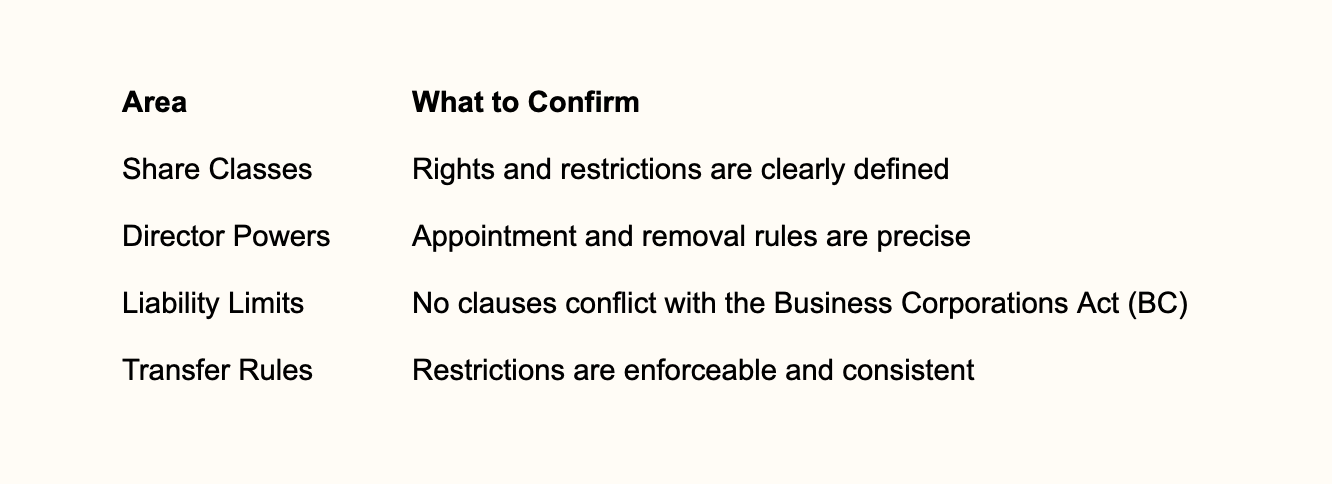
You should consult a corporate lawyer if your structure includes multiple shareholders or special share rights. Clear drafting at the start protects your ownership position and reduces risk.
The Final Verdict
The articles of incorporation play a critical role in defining ownership, control, and liability within a BC corporation. Carefully structuring these documents can help prevent disputes, clarify decision-making authority, and protect those involved in the business.
For expert guidance on drafting or reviewing articles of incorporation, contact the attorneys at Parr Business Law. Our team can help ensure your corporate structure is clear, compliant, and aligned with your business objectives.