
Trusts for Blended Families in BC: What Are Your Options?

In a blended family, wanting to care for both your partner and your children is natural, but standard estate plans rarely make it easy. Leaving assets outright can inadvertently compromise your children's financial future once you are gone. In British Columbia, relying on a basic will can backfire, as a standard document alone cannot guarantee your complex wishes will be carried out or prevent future disputes.
This article explores how different trust structures work, how they compare, and how to choose the right option to protect your family's future under BC law.
Why a Blended Family Needs More Than a Simple Will
Second marriage estate planning often reveals the limitations of a basic will. Many people assume that if they leave everything to their current spouse, their spouse will eventually pass the remaining assets down to all the children. Unfortunately, a simple will cannot guarantee this outcome.
An outright transfer grants a surviving spouse absolute legal ownership of inherited assets. Consequently, future legal and financial decisions, including new wills, remarriage, or unexpected liabilities, can redirect those assets away from your children. To ensure your wishes are legally protected against changing circumstances, formal planning is required, as informal agreements may not carry legal weight.
However, it is worth noting that British Columbia law restricts your ability to disinherit your immediate family completely. Under Section 60 of the Wills, Estates and Succession Act (WESA), your legally married spouse, common-law partner (a person you have lived with in a marriage-like relationship for at least two years) and biological or adopted children have the right to apply to the court for variation of your will. This mechanism is known as a wills variation claim.
In a blended family, the court may have to balance the will-maker's legal and moral obligations to a surviving spouse and children from different relationships. The Supreme Court of Canada’s decision in Tataryn v Tataryn Estate established that, when determining whether a will makes adequate, just and equitable provision, courts consider both the will-maker's legal obligations and moral obligations. If the court concludes that the will does not make adequate provision for a spouse or child, it can vary the will under WESA. Relying on a basic will in a blended family often creates tension, uncertainty, and legal exposure.
How a Trust Protects Both Your Spouse and Your Children
A trust may resolve competing interests by separating the right to use an asset from its absolute legal ownership. When you place property, investments, or corporate shares into a trust, you appoint a trustee to manage those assets for the benefit of your chosen beneficiaries.
This structure allows you to provide for your spouse during their lifetime with the intent that the remaining funds will eventually pass to your children. The trust acts as a protective container. Your spouse receives the financial support they need, but because they do not personally own the underlying capital, they generally cannot redirect it to their own children unless the trust terms give them that power.
Careful estate planning can structure provision for a spouse and children in a way that may reduce disputes and better implement the will-maker's intentions.
Spousal Testamentary Trust
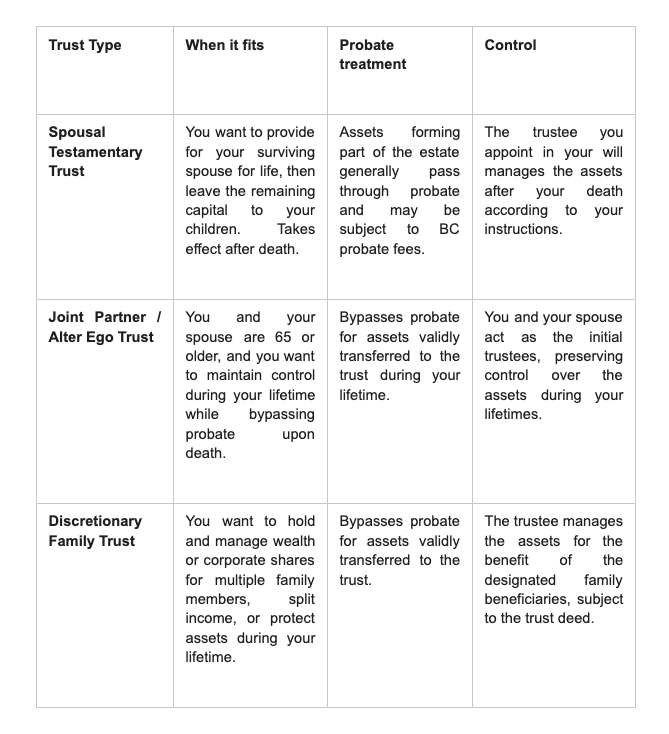
Another option is a spousal testamentary trust. This is a specific type of trust created within the text of your will. It comes into existence upon your death and is funded during the estate administration process.
When you establish a spousal testamentary trust, you direct your executor to transfer specific assets into the trust rather than giving them directly to your spouse. For a trust to qualify as a tax-qualified spousal or common-law partner trust under Canadian tax rules, the surviving spouse must be entitled to all income arising before their death, and no other person can receive or obtain the use of the trust's income or capital before the spouse's death.
When your spouse eventually passes away, the trust terminates according to its terms, and the remaining capital passes to the remainder beneficiaries you originally named (typically your children). A spousal trust is highly effective for securing an inheritance. It can also provide a degree of structural protection, depending on the circumstances, against future creditors.
Joint Partner and Alter Ego Trusts
While testamentary trusts are created upon death, inter vivos trusts are established while you are still alive. If you are 65 years of age or older and a resident of Canada, you have access to specialized inter vivos trusts known as alter ego trusts (for individuals) or joint spousal/common-law partner trusts.
These trusts allow you to transfer assets for the exclusive benefit of you and your spouse. For the trust to qualify under the Income Tax Act, you and your spouse must be the only persons entitled to receive or use its income or capital during your lifetimes. Acting as trustee can preserve significant control over your investments and property as long as you maintain capacity.
When the second partner passes away, the remaining assets are distributed in accordance with the trust terms after the death of the surviving lifetime beneficiary.
The primary advantage is that assets validly transferred to the trust do not form part of your probate estate. This bypasses the probate process for those specific assets, and probate fees under the Probate Fee Act can be costly. Furthermore, avoiding probate ensures greater privacy, as probate records are generally public court documents. For more information on the probate process, you can check out our resources.
Comparing the Options: Which Trust Fits Your Family?
Choosing the right trust vehicle depends on your age, the types of assets you own, your desire for privacy, and your primary goals. To explore the broader advantages of utilizing trusts, you can read our breakdown of the Benefits of Family Trusts.
Other Tools to Consider Alongside a Trust
Mutual wills are another mechanism frequently discussed in second marriage estate planning. Less flexible than a trust, they create binding contractual obligations that can offer an extra layer of security.
You must also carefully coordinate your trust strategy with your direct beneficiary designations. Proper beneficiary designations on accounts like life insurance policies, Registered Retirement Savings Plans (RRSPs), and Tax-Free Savings Accounts (TFSAs) can result in direct payment outside the estate. However, the tax treatment varies greatly. Life insurance proceeds are generally received tax-free by a beneficiary. Naming a spouse as a successor holder allows a TFSA to continue tax-free, whereas ordinary beneficiaries can receive the date-of-death value tax-free, but any post-death growth may be taxable. RRSPs similarly carry separate income-tax consequences.
Common Mistakes That Put an Inheritance at Risk
Joint tenancy risks occur when couples add each other as joint owners to their home or bank accounts, assuming it is an easy way to pass things on. However, joint ownership usually means the surviving owner automatically gets 100% of the asset upon your death, bypassing your will and trusts entirely. If your goal is to ensure your share of the property eventually goes to your own children, joint tenancy can accidentally cut them out.
Ignoring corporate assets is another frequent error, as private company shares cannot just be lumped into a standard personal will without proper coordination. Business owners must make sure their corporate structures are properly integrated into their overall trust and estate plan.
Failing to document reasons behind your choices can also invite litigation, but WESA Section 62 expressly permits the court to consider evidence of the will-maker's reasons. Including a signed written statement or memorandum gives the court something to weigh when evaluating a potential variation claim.
Building Your Blended-Family Plan With Parr Estate Planning
Navigating the intersection of family obligations, business assets, and provincial law requires precise drafting. At Parr Business Law, we handle these delicate dynamics under our Parr Estate Planning register. We operate with a simple philosophy: estate planning, made clear. Our team focuses on building strategies that minimize family friction, manage tax liabilities, and respect your wishes.
Frequently Asked Questions
Do stepchildren automatically inherit in BC?
No. Under British Columbia intestacy legislation, distribution is to the deceased's spouse and descendants. Stepchildren are not included merely by being stepchildren. If you want your stepchildren to inherit any portion of your estate, you must explicitly name them.
Can a surviving spouse change the plan after I die?
If you leave your assets to your spouse outright, they become the absolute owner and can change their own will at any time. However, if you place the assets into a properly structured trust, the trustee and trust terms determine what the spouse can receive or control, preserving the remaining capital for your beneficiaries.
What is the difference between a spousal trust and a joint partner trust?
A spousal trust is a testamentary trust created in your will that takes effect after you die and goes through probate. A joint spousal or common-law partner trust is an inter vivos trust created while you are alive (if 65 or older), allowing transferred assets to bypass probate.
Key Takeaways
Basic Wills Are Insufficient: Leaving assets outright to a new spouse removes your ability to guarantee an inheritance for your children from a previous relationship.
Trust Protections: Trusts separate the right to use an asset from absolute ownership, allowing you to provide for your spouse while preserving capital for your children.
WESA Obligations: Proper planning helps satisfy your legal obligation to make adequate provision for your spouse under WESA, reducing the risk of a wills variation claim.
Probate Avoidance: Joint spousal or common-law partner trusts allow you to bypass the British Columbia probate process for assets validly transferred to the trust.
Coordinated Planning: A secure estate plan requires aligning your trusts, mutual wills, corporate shares, and direct beneficiary designations carefully regarding tax consequences.
Need Advice?
If you are concerned about protecting your blended family's future, book a consultation with Parr Business Law. Our Vancouver estate lawyers can review your circumstances and build a comprehensive strategy to protect your legacy.
This article provides general information only and does not constitute legal advice. Estate laws are complex and depend on individual circumstances. Obtain advice based on your specific situation.
Sources & References
Note: AI tools were utilized to assist in drafting, structuring, and refining this article for clarity.
Section 60 and Section 62 of BC's Wills, Estates and Succession Act (WESA)
Tataryn v Tataryn Estate, [1994] 2 SCR 807